Panther Head
First Impressions: Quirky, Confident, and Surprisingly Versatile
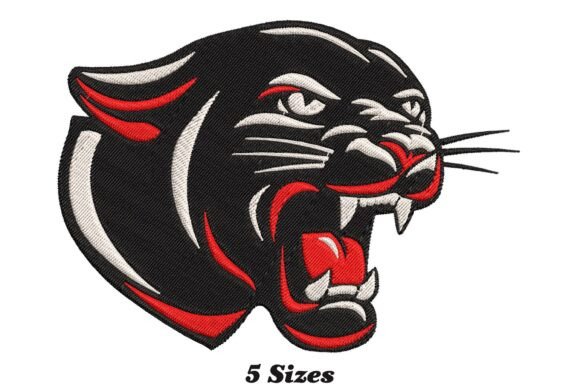
When Panther Head landed in my inbox, I paused mid-coffee sip—not because it’s flashy or overdesigned, but because it *feels* intentional. It’s not a roaring predator or a hyper-realistic wildlife portrait. It’s a stylized, slightly playful panther head with clean contours, balanced negative space, and just enough detail to read as feline without tipping into cartoonish territory. The shape sits comfortably within a medium oval footprint—neither sprawling nor cramped—making it immediately useful for real-world embroidery projects like tote bag fronts, sweatshirt chest placements, or pillow covers.
A Real-World Test: That Custom Embroidered Tote for a Local Bookstore
Last week, I used Panther Head on a natural cotton canvas tote for a neighborhood indie bookstore’s staff gift set. No frills—just black thread on off-white fabric, medium-weight cutaway stabilizer, and a standard 4×4 hoop. The result? Crisp satin-stitched outlines, smooth fill stitch in the ears and muzzle, and no puckering—even across the slight curve of the tote’s gusset seam. Customers noticed it right away: “Is that a panther? It’s cool—but not scary.” That’s the sweet spot. Panther Head doesn’t shout; it invites a second look. It reads as handmade, confident, and quietly clever—exactly what small shops want in their branded merchandise.
Where Panther Head Shines (and Where It Asks for Thought)
This machine embroidery design thrives in contexts where charm and clarity matter more than photorealism:
- Custom apparel: Works beautifully on crewneck sweatshirts and relaxed-fit tees—especially when placed left-chest or centered on the back. The clean silhouette avoids visual competition with textured knits.
- Towels & kitchen textiles: On tea towels or linen napkins, Panther Head adds personality without overwhelming the fabric’s grain. Just avoid ultra-thick terry loops unless you adjust stitch density manually.
- Baby and nursery items: Used on a soft cotton muslin blanket, it read as gentle and modern—not fierce—thanks to its rounded lines and open eye shape. Ideal for gender-neutral baby gifts.
- Embroidered patches: With a simple merrow border added in your editing software, Panther Head becomes a standout iron-on or sew-on patch for denim jackets or backpacks.
- Holiday and boutique gifting: Paired with minimalist typography (“Wild at Heart” or “Panther Club”) on a cream drawstring bag, it feels curated—not mass-produced.
Use With Care: Practical Boundaries You’ll Want to Respect
Panther Head is forgiving, but not magic. Here’s where attention pays off:
- Thin or stretchy fabrics: On lightweight rayon or jersey, skip tear-away alone—layer it with a light fusible or baste first. Those smooth curves can distort if the base shifts mid-stitch.
- Dark fabric backgrounds: The design relies on outline definition. On charcoal or navy, test white or metallic thread—some satin stitches lose contrast if thread sheen clashes with fabric depth.
- Caps and curved surfaces: It fits a front cap panel, yes—but avoid placing it too low near the bill curve. The ear details may compress slightly. A slight upward tilt in placement helps preserve proportion.
- Small hoop sizes (under 3.5”): While scalable, shrinking Panther Head below ~2.75” risks losing definition in the inner ear line and eye shape. If you need tiny, consider simplifying manually—or choosing a dedicated mini version.
- Frequent-wash items: For baby onesies or kitchen towels, reinforce with a light topping stabilizer or water-soluble film over the top layer. Dense fill areas hold up well, but satin edges benefit from extra security.
What Panther Head Says About Your Finished Product
It quietly elevates perception. When stitched cleanly, Panther Head signals care—not just in execution, but in curation. Customers don’t see “wild animal embroidery”; they see intentionality. That translates directly to perceived value: a $28 embroidered apron feels like a boutique piece, not a craft fair afterthought. For Etsy sellers, it performs well in printable mockups—its balanced shape scales cleanly across product templates, and it reads clearly even in black-and-white previews (a must for thumbnail visibility). And for craft businesses building brand consistency, Panther Head slots neatly into a “nature-meets-modern” aesthetic—pairing naturally with botanical motifs, geometric borders, or minimalist typography.
Designer Notes You’ll Actually Use
Before stitching your first Panther Head project:
- Always test on scrap fabric—same type, same stabilizer, same thread colors you plan to use.
- Review stitch density in your editing software. If it’s dense in the face area, consider reducing fill density by 5–10% for breathable fabrics.
- Check hoop size compatibility before sending to your machine—especially if you’re using older hoops or multi-position frames.
- Inspect small details at 200% zoom: the inner ear line, the subtle curve of the jaw, and whether the eye shape stays open and friendly—not pinched or ambiguous.
- Test black-and-white mockups to confirm readability on both light and dark backgrounds.
- Confirm licensing terms before selling finished items or bundling Panther Head as part of a digital embroidery file pack—this applies whether you’re an Etsy seller or a wholesale craft business.
- Match stabilizer to fabric texture: cutaway for knits, tear-away for stable wovens, and light fusible + topping for delicate linens.
Final Thought: Not Just Another Wild Animal Design
Panther Head stands apart because it doesn’t try to be everything. It’s not aggressive, not overly sweet, not technically demanding—and that’s its strength. It’s a reliable, expressive, and commercially smart embroidery file that works as hard on a holiday gift tag as it does on a boutique sweatshirt line. If you’re curating design assets for your craft business—or simply choosing your next embroidered patch—it earns its place not through novelty, but through quiet, consistent performance. It’s the kind of design that makes customers pause, smile, and ask, “Where did you get that?”—and that, for any maker, is the best kind of endorsement.